Today’s riddle is…

In December, many countries bring a tree into their homes.
But in Japan, people place two round rice cakes on a small stand.
No lights.
No ornaments.
Just white mochi, an orange on top, and quiet intention.
Why?

“I see Christmas trees everywhere in other countries.
But in Japan, people decorate with… food?”

“Yes. And not to look at forever—but to eat.”

“Eat the decoration?!”
What Kagami Mochi Really Is
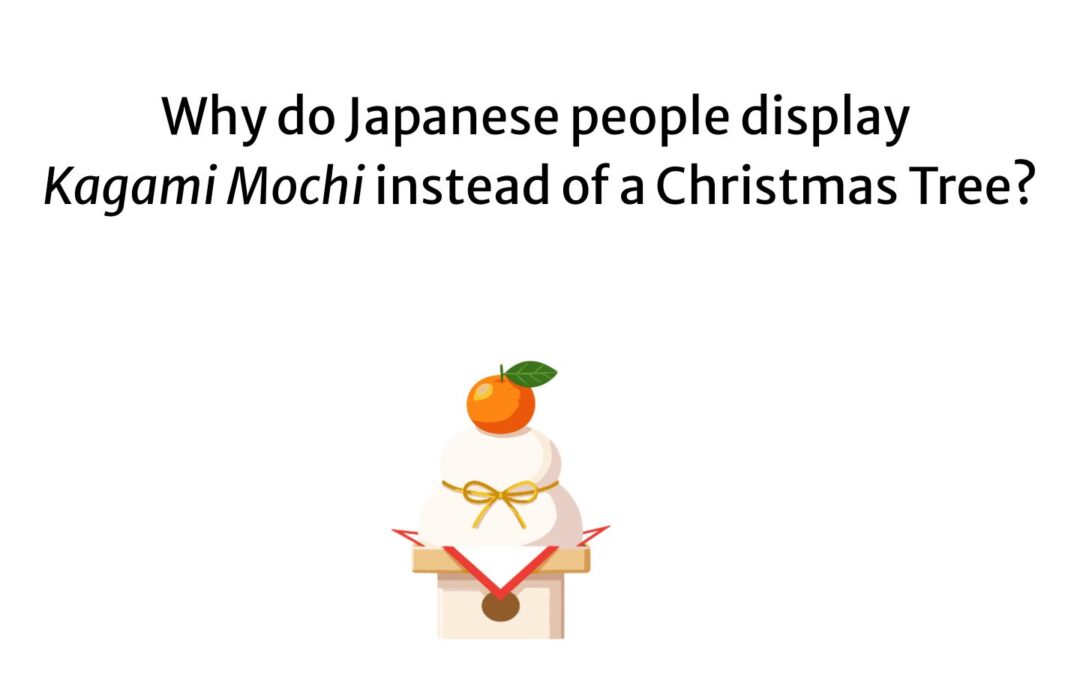
Kagami mochi (鏡餅) is a traditional New Year decoration made of
two round rice cakes stacked together, usually topped with a daidai (Japanese bitter orange).
It is displayed from the end of December until January 15th.
But this is not just decoration.
The mochi represents:
-
Continuity (the round shape has no beginning or end)
-
Harmony and wholeness
-
A place for the New Year deity (Toshigami-sama) to visit the home
In other words, kagami mochi is not for humans.
It is prepared for the gods.
Kagami Mochi vs Christmas Tree
A Christmas tree is:
-
Decorated
-
Admired
-
Preserved until the season ends
Kagami mochi is:
-
Displayed quietly
-
Respected
-
Eventually broken and eaten
This difference reveals something deeply Japanese.
Kagami Biraki: Breaking, Not Cutting
On January 11th or 15th, families perform kagami biraki (鏡開き).
The mochi is broken by hand or hammer, never cut with a knife.
Cutting is avoided because it symbolizes separation or bad luck.
The broken mochi is then cooked and eaten:
-
In ozoni (New Year soup)
-
Or oshiruko (sweet red bean soup)
By eating the mochi, people believe they receive:
-
The blessing
-
The strength
-
And the good fortune of the New Year deity
A Decoration That Becomes Part of You
“So the decoration doesn’t just disappear… it becomes part of you?”
“Yes. Blessings are not thrown away.
They are shared.”
Why This Matters
In Japan, tradition is not about preserving objects.
It is about continuing meaning.
Kagami mochi teaches that:
-
Nothing sacred stays untouched forever
-
Gratitude is shown through use, not display
-
Even food can be a bridge between humans and the divine
The Answer to Today’s Riddle
Japanese people don’t decorate for New Year the way others do.
They prepare something sacred,
welcome the unseen,
and then quietly take it into themselves.
That is why Japan has kagami mochi—
instead of a Christmas tree.